

You and your team are facing a major transition.
The strategy is sound.
Will your people truly drive it forward?
Let’s make sure they will.
Every transition is first and foremost a transition of people. Yet, transitions are usually planned as a matter of strategy, structures, and timelines. When people are not engaged, understood, and seen along the way, momentum can be lost: this shows up as resistance, mistrust, loss of ownership, and prolonged discontent. That is why the human side of change is as decisive as the strategy itself.
Through strategic advisory and public speaking, I help leaders work with the human dynamics, before a transition begins and while it unfolds, so that their people drive it forward and the transformation holds.
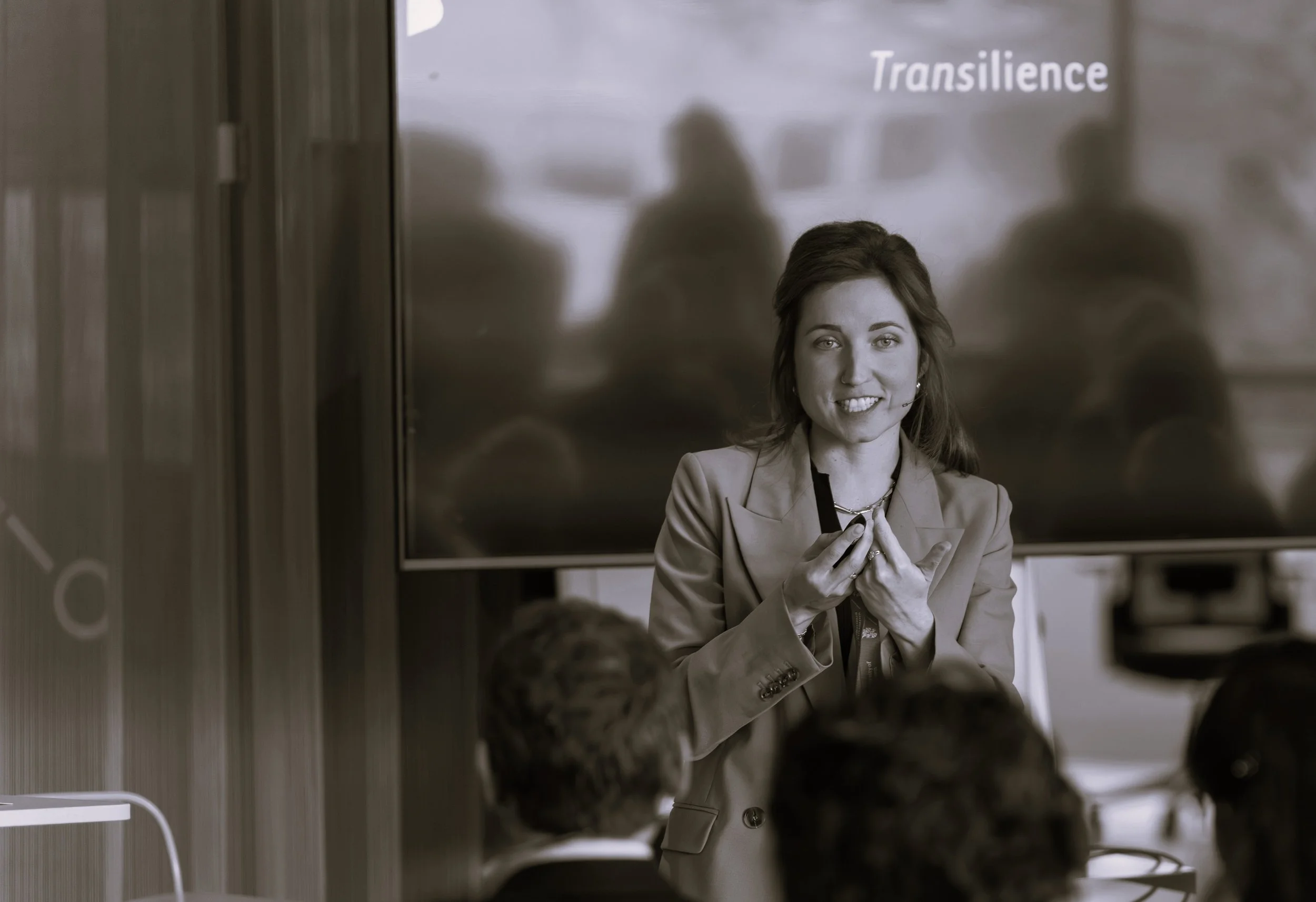
My mission is to help leaders and organizations build the human capacity to move through major transitions, so that disruption becomes an opportunity to grow and to reinvent themselves and their systems.
Why my approach is different
I have always been interested in how people adapt in the face of disruption, yet I could not find a way to clearly explain how people evolve through it rather than just cope with it. So I set out to develop one.
Transilience is a concept I introduced during my PhD in the Psychology of Climate Change Adaptation. It captures the capacity to persist, adapt flexibly, and positively transform in the face of disruption, and research shows it is measurable, predictive, and distinct from traditional resilience. My work on Transilience® builds on this foundation but is designed for real contexts, where pressure, complexity, and human dynamics shape what actually happens.
Trusted by Institutions & Global Platforms:




The Process: Working with disruption
1. DIAGNOSE: identify the human dynamics shaping your transition.
We identify the main breaking points for progress and gain clarity on the human dynamics that are driving resistance, mistrust, or loss of momentum.
You understand what you need to focus on.
2. REFRAME: see disruption differently, and work with it.
We shift how the situation is understood: not as something to push through or minimize, but as a signal of what needs to change. Discomfort becomes information, not an obstacle.
You have a clearer direction.
3. DESIGN: define the conditions for progress to move and hold.
Through the Transilience® lens, we define the key adjustments in how the transition is led (how people are engaged, how decisions are made, and where to intervene) so the transition can move forward and hold.
You are better equipped to lead through disruption, now and in the future.
How can we work together?
Every engagement starts from your specific situation, whether a transition is already underway or you want to build the right conditions before one begins. If you are not sure where to start, a scoping call is the right first step.
-
A structured diagnostic engagement to understand the human dynamics shaping a transition and what is influencing its progress.
We examine the human dynamics shaping the situation: resistance patterns, trust erosion, loss of meaning, and what is depleting people's capacity to persist and adapt. From there, we define targeted recommendations to strengthen the conditions for persistence, adaptability, and transformability within your organization or leadership context. You leave with clarity on what is happening and a concrete direction for what needs to change.This engagement is relevant both for transitions already underway and for leaders who want to build the right conditions before one begins.
-
A structured engagement for leaders who need more than a diagnosis. Once we have clarity on the human dynamics at play, we work together to reframe how the transition is being understood and led. This means clarifying the real adaptive challenges, distinguishing productive discomfort from destructive friction, and designing the leadership shifts and engagement conditions that allow the transition to move forward in a way that builds trust and holds over time. You leave with a reframed understanding of your situation and a concrete strategy for leading it differently.
-
A sustained partnership for leaders navigating high-stakes or long-horizon systemic transitions. This engagement goes beyond strategy to embed adaptive capacity at the institutional level: in how decisions are made, how people are engaged, and how the organization responds to ongoing disruption. The scope, format, and duration are designed around your specific context. You leave not only better equipped for the current transition, but with strengthened conditions for persistence, adaptability, and transformability that carry forward into whatever comes next.
-
Speaking and workshops are where the Transilience® perspective meets a room. Whether you are organizing a conference, a leadership summit, or an institutional event, this is an opportunity to give your audience a genuinely different understanding of how people and systems move through disruption. Talks and workshops are tailored to your audience, context, and goals, and are available in English, Italian, Spanish, and Dutch.
See ‘Speaking’ section for more information.
The Transition cannot wait. Will you?
The strategies are in place. The direction is clear.
What’s missing is making sure your people are ready to carry it forward.